A home lab for practicing alert triage: a Windows Server 2025 endpoint sends Security and Sysmon logs to a Wazuh server. I simulated two attack scenarios, investigated the alerts they produced, and wrote a triage note for each.
Both machines run as virtual machines in VMware Workstation on my laptop, on a private host network.
| Scenario | Simulated activity | Wazuh alerts | Verdict |
|---|---|---|---|
| 1 | 10 failed logons against a non-existent account | 60122 (level 5), 60204 (level 10) | Benign true positive |
| 2 | New local account added to Administrators | 60109 (level 8), 60154 (level 12), 60111 (level 8) | Benign true positive |
Both scenarios were authorized tests I ran myself on 19 November 2026. All times on this page are WIB (UTC+7).
| Host | WIN-LAB01 (Wazuh agent 001) |
| Alerts | 60204 Multiple Windows Logon Failures (level 10) · 60122 Logon Failure - Unknown user or bad password (level 5) |
| Source event | Windows Security Event ID 4625 |
| Verdict | Benign true positive: authorized lab simulation |
| Time | Event |
|---|---|
| 22:38:12 | First failed logon for labtest (event record 1026) |
| 22:38:26 | 8th failed logon (record 1033): rule 60204 fires (frequency threshold = 8) |
| 22:38:27 | Alert 60204 indexed by Wazuh (about 1 s ingestion delay) |
| 22:38:30 | Last failed logon (record 1035) |
10 attempts in total, about 2 seconds apart. Individual failures fired rule 60122; the 8th was escalated to 60204 instead.
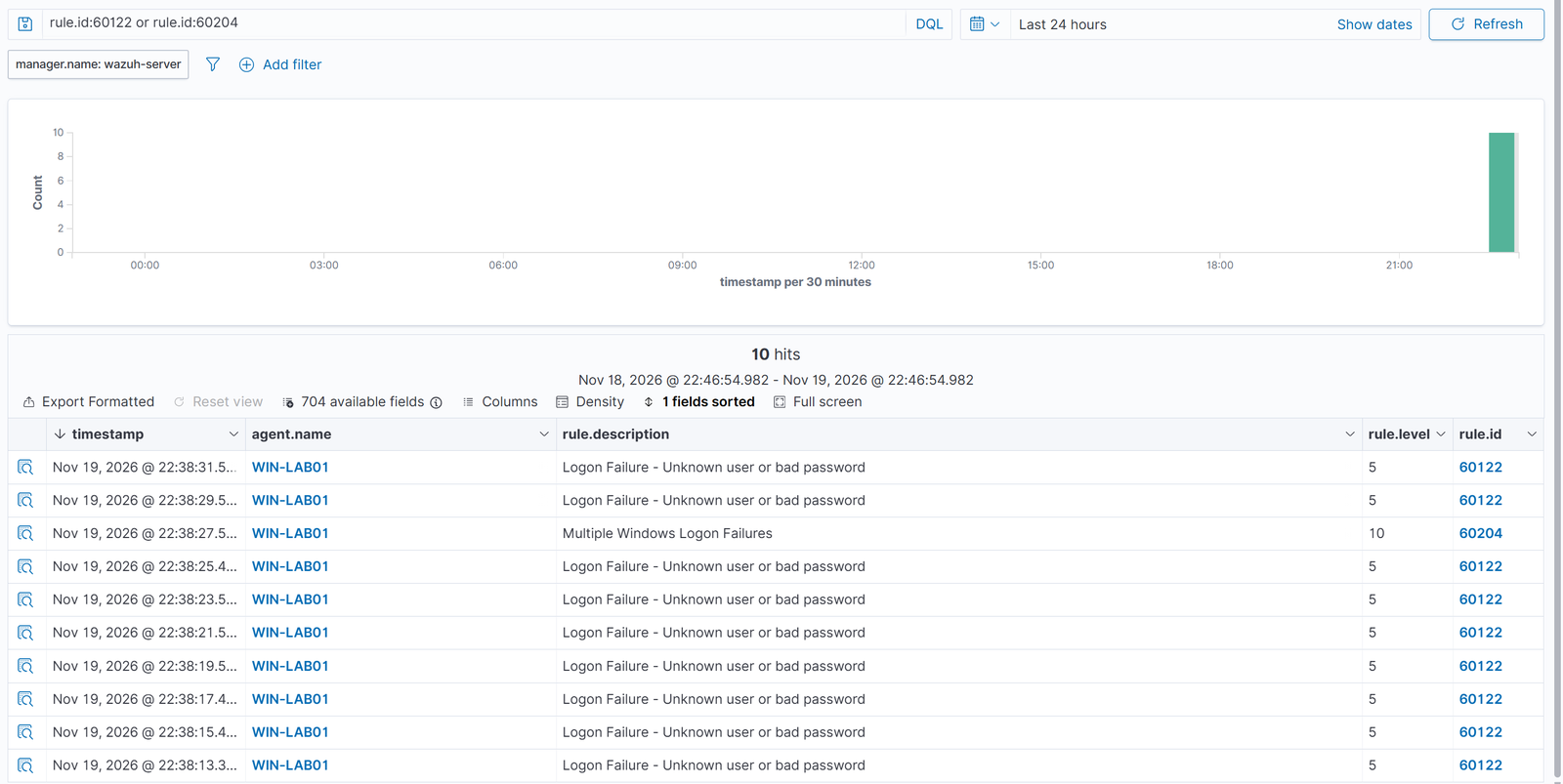
rule.id:60122 or rule.id:60204: 10 hits, with 60204 (level 10) in place of the 8th 60122.| Field | Value | Meaning |
|---|---|---|
targetUserName | labtest | Account targeted |
subStatus | 0xC0000064 | Username does not exist |
targetUserSid | S-1-0-0 | NULL SID, consistent with a non-existent account |
logonType | 2 | Interactive logon |
logonProcessName | seclogo | Secondary Logon service (RunAs / Start-Process -Credential) |
ipAddress | ::1 | Local origin, not network |
subjectUserName | Administrator (RID 500) | Account that requested the logons |
subjectLogonId | 0x3F339 | Same session for all 10 attempts |
Between 22:38:12 and 22:38:30, 10 failed logon attempts were made against the account labtest on WIN-LAB01. The account does not exist on the host (subStatus 0xC0000064). The attempts were made locally (logonType 2, ipAddress ::1) from the Administrator session 0x3F339. The alerts match activity that actually occurred, and the time and method match the test script I ran, so the verdict is benign true positive.
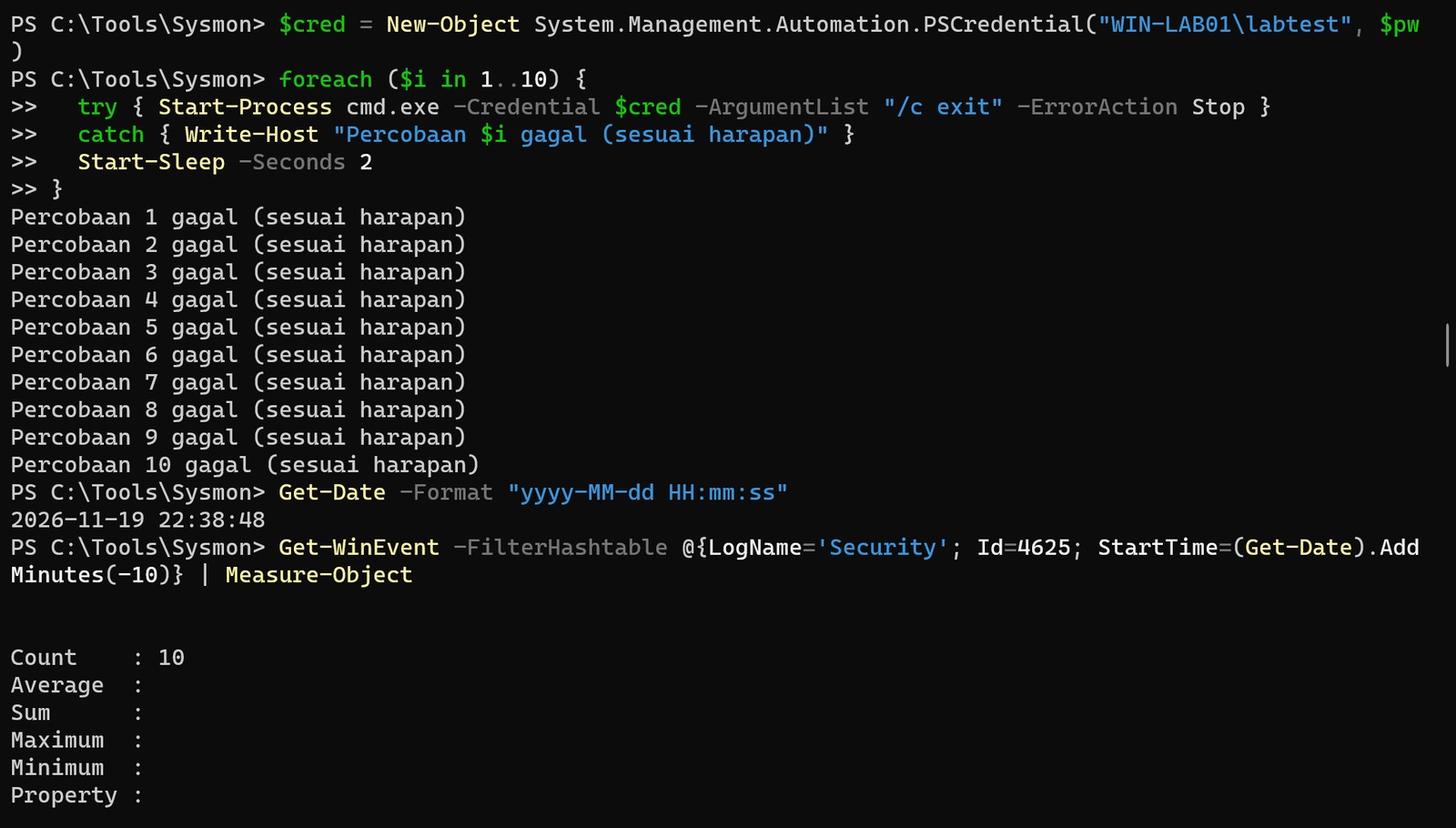
Get-WinEvent counts 10 Event ID 4625 entries, matching the 10 alerts in Wazuh.| Technique | Notes |
|---|---|
| T1110 Brute Force (Credential Access) | Matches Wazuh's built-in mapping for 60204 |
Wazuh's built-in mapping for 60122 is T1531 Account Access Removal (Impact). That does not fit this event, since a failed logon does not remove anyone's access, so I reclassified it to T1110.
0x3F339 cannot be attributed to an authorized user or task.ipAddress).subStatus 0xC000006A, wrong password).Next pivots: Sysmon Event ID 1 filtered by LogonId 0x3F339 to identify the process that generated the attempts; 4624 and 4740 (lockout) for the targeted account.
Response: none required (authorized test). No accounts were created, so no cleanup was needed.
| Host | WIN-LAB01 (Wazuh agent 001) |
| Alerts | 60154 Administrators Group Changed (level 12) · 60109 User account enabled or created (level 8, fired for 4720 and 4722) · 60111 User account disabled or deleted (level 8, cleanup) |
| Source events | Windows Security Event IDs 4720, 4722, 4732, 4726 |
| Verdict | Benign true positive: authorized lab simulation |
| Time | Event ID | Record | Event |
|---|---|---|---|
| 22:47:43 | 4720 | 1045 | First attempt: svc-backup created with SID …-1000 |
| 22:47:43 | 4722 | 1046 | …-1000 enabled |
| 22:47:43 | 4726 | 1049 | …-1000 deleted in the same second: automatic rollback after the password was rejected for complexity |
| 22:48:17.692 | 4720 | 1051 | Second attempt: svc-backup created with SID …-1001 |
| 22:48:17.693 | 4722 | 1052 | …-1001 enabled |
| 22:48:29.003 | 4732 | 1057 | …-1001 added to Administrators (S-1-5-32-544): rule 60154 |
| 23:15:59.907 | 4726 | 1083 | svc-backup (…-1001) deleted during cleanup: rule 60111 |
The account went from creation to local admin in about 11 seconds.
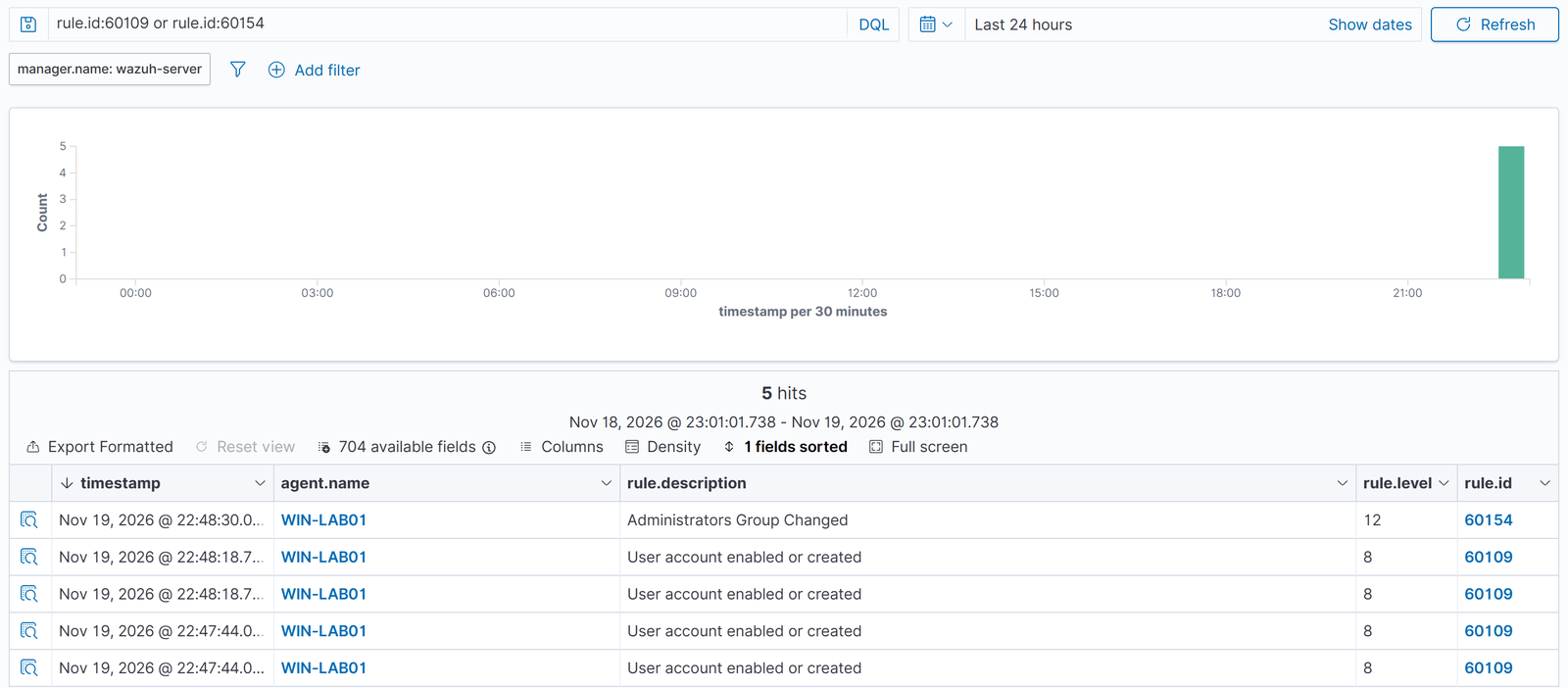
rule.id:60109 or rule.id:60154: four 60109 alerts (two per creation attempt) and the level 12 alert 60154.| Field | Value | Meaning |
|---|---|---|
targetUserName (4720) | svc-backup | New account |
targetSid (4720, 4722, 4726) | S-1-5-21-…-1001 | SID of the account under investigation |
targetSid (4732) | S-1-5-32-544 | Built-in Administrators group |
memberSid (4732) | S-1-5-21-…-1001 | Same SID as the new account |
subjectUserName | Administrator (RID 500) | Account that performed every action |
subjectLogonId | 0x3F339 | Same session for 4720, 4722, 4732, 4726, and Scenario 1 |
newUacValue (4720) | 0x15 | Disabled + Password Not Required + Normal Account at creation |
PasswordRequired (endpoint) | False | The flag was still set after the account was enabled |
-, which is normal for local accounts. The member SID …-1001 matches the targetSid of the 4720 event, so the account added to Administrators is svc-backup.0x3F339. Scenario 1 ran in the same session.svc- prefix also resembles a service account, which attackers use to blend in.newUacValue 0x15. After the password was set and the account enabled, Get-LocalUser still reported PasswordRequired = False. The account does have a password, but the flag allows a blank password to be set later, and accounts carrying it are a common hardening finding. A control test on the same host showed the flag comes from the creation method: an account created with net user <name> <password> /add reported PasswordRequired = True. In a real environment, find them with Get-LocalUser | Where-Object { -not $_.PasswordRequired } and fix with net user <name> /passwordreq:yes.svc-backup received 1001. The endpoint log shows 4720, 4722, and 4726 for …-1000 within the same second: New-LocalUser created the account, then rolled it back when the password was rejected, which matches the complexity error I got. The Wazuh counter agrees: rule 60109 shows firedtimes 3 and 4 on records 1051 and 1052, so it had already fired twice (records 1045 and 1046). In a real investigation, an account created and deleted within one second could also be an attacker cleaning up; here the event sequence corroborates the command error.
Get-LocalUser on the endpoint: svc-backup is enabled with PasswordRequired = False.
…-1000 within one second (the rolled-back first attempt), then 4720 and 4722 for …-1001.| Event | Technique | Wazuh built-in mapping |
|---|---|---|
| 4720 | T1136.001 Create Account: Local Account (Persistence) | T1098 Account Manipulation: too generic for account creation |
| 4732 | T1098.007 Account Manipulation: Additional Local or Domain Groups (Persistence, Privilege Escalation) | T1484 Domain Policy Modification: does not fit, since no domain or policy was changed |
Rule 60111 (4726) is mapped by Wazuh to T1098 / T1531. I did not map it, because this deletion was my own cleanup, not attacker activity.
0x3F339 or the subject account cannot be attributed to an authorized administrator.targetUserName = svc-backup), especially remotely (logon type 3 or 10).LogonId) is unexpected, for example net.exe spawned by an Office application or a web server process.Response: authorized test. Cleanup: svc-backup removed with Remove-LocalUser at 23:15:59 (Event ID 4726, record 1083, Wazuh rule 60111).
Open item. Rule 60111 on the cleanup event shows firedtimes: 1. If the counter is cumulative, as it is for 60109, the rollback deletion at 22:47:43 (record 1049) may not have produced a 60111 alert. To check: filter data.win.system.eventID:4726 in Wazuh and confirm whether both deletions were alerted.

